On October 9, 2025, China’s Ministry of Commerce quietly published a list. Some of the highest-energy lithium-ion cells available today. Cathode precursors. Graphite anodes. The equipment and know-how to make all of it. Every item would need an export license to leave the country.1
Just days before the rule took effect, Beijing suspended it. The suspension runs until November 10, 2026. It is temporary, and nobody knows if controls will come back.2
Here is why that matters. The International Energy Agency puts China’s share at 80% or more across most of the battery supply chain.3 RealClearDefense puts cathode capacity at 85% to 90% in China and anode capacity above 97%, and calls the pause “time to build rather than time to debate.”4
The Pentagon already knows.
At a joint Army, Navy and Marine Corps battery industry day, the Navy’s deputy director for operational energy put it bluntly: “We need these batteries yesterday.” 5
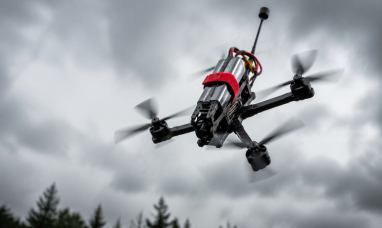
The Defense Innovation Unit told Reuters this month that Ukraine will build six to seven million first-person-view (FPV) drones this year while the Pentagon expects to have ordered fewer than 200,000 by February 2027, and that its next Drone Dominance trial bars Chinese motors and batteries outright.6
Congress wrote the deadline into law. Section 842 of the FY2026 National Defense Authorization Act, signed December 18, 2025, bars the Department of War from buying advanced batteries, cells or key components owned, sourced, refined or produced by a foreign entity of concern. It phases in from January 1, 2028 for new contracts.7,8
So the US needs a domestic cell supply, on a timeline, and it needs cells good enough that soldiers, drones and satellites will carry them into harm’s way. The problem is that a battery is only as good as the materials inside it, and those materials have been stuck at the same physics for years.
One company has spent fifteen years solving that at the atomic level. It just became a public company.
Forge Nano Holdings, Inc. (NASDAQ:NANO) began trading on the Nasdaq in October after completing its business combination with Archimedes Tech SPAC Partners II, the same sponsor team that took SoundHound AI public in 2022.9
It is not a battery company and it is not a semiconductor company.
It owns a coating process called Atomic Armor that makes existing materials perform better, one atomic layer at a time, and it sells that process today through two revenue lines: high-throughput semiconductor tools and US-made lithium-ion cells. One process sits underneath both, and that is what makes Forge Nano Holdings, Inc. (NASDAQ:NANO) a platform rather than a product.
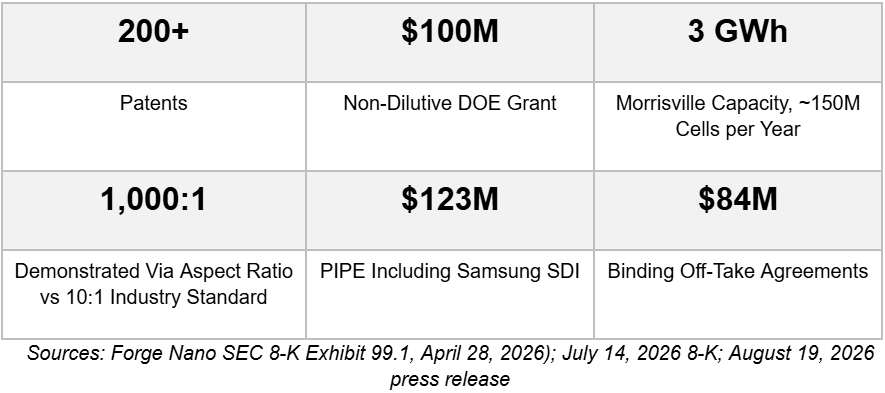
Forge Nano Holdings, Inc. (NASDAQ:NANO) enters public markets already backed by real money: a strategic partnership and $20 million from Samsung SDI, a $100 million non-dilutive grant from the Department of Energy, and over $220 million raised pre-listing to fund the ramp.
Fog, Not Rain: The Sixty-Year-Old Process Forge Nano Finally Made Fast
Atomic layer deposition (ALD) has existed since the 1960s. It builds a coating one atomic layer at a time, and because each layer self-saturates, the result is pinhole-free and exactly as thick as you want.
Chipmakers use it. So does the solar industry. Almost nobody else does, because conventional ALD is slow and wastes expensive precursor chemicals. That gap is where Forge Nano Holdings, Inc. (NASDAQ:NANO) comes in.
Lichty explains the difference with weather. Traditional ALD flows its chemistry in one direction, like rain in a city: one side of every building gets wet, the other stays dry. Forge Nano‘s (NASDAQ:NANO) turbulent-flow process behaves like fog. In his words, “that fog can coat all sides of the buildings. It can actually go under underhangs and into the parking garage.”
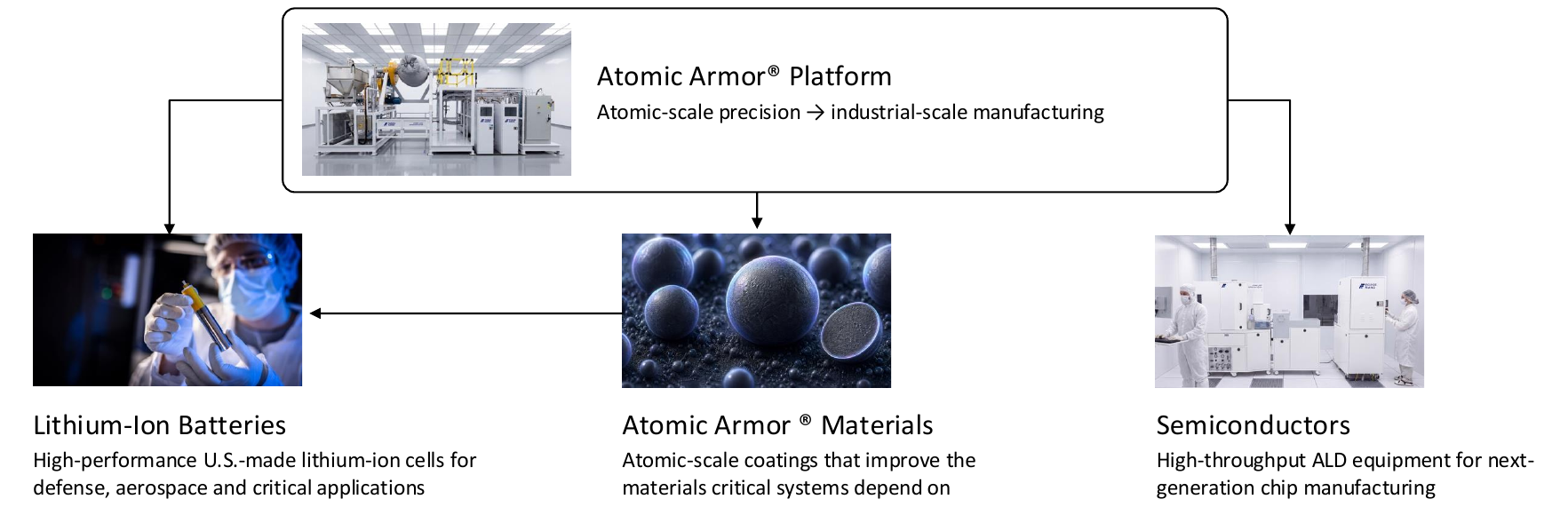
The practical result is a tool that runs “10 times faster than the competing equipment,” is “almost 100 times more efficient with our precursor utilization,” and coats features the incumbents cannot reach.
That last point is the one AI investors researching Forge Nano Holdings, Inc. (NASDAQ:NANO) should underline.
The AI Angle: Coating the Inside of a Straw at 1,000 to 1
Every data center being built this year is fighting the same constraint: energy per unit of compute. One of the industry’s answers is 3D packaging, stacking memory and logic vertically so signals travel shorter distances and generate less heat. The bottleneck is the through-silicon via, a hole so deep and narrow that Lichty compares it to “a long straw.” Its walls must be coated before copper is plated in, and the state of the art manages an aspect ratio of about 10 to 1.11
Forge Nano Holdings, Inc. (NASDAQ:NANO) has shown and published 1,000 to 1.12 That is not an incremental improvement over Applied Materials, Lam Research, ASM International and Tokyo Electron, the four companies that held about 72% of ALD equipment revenue in 2025.13 It is a different capability, and it arrives as McKinsey estimates roughly $1 trillion of new fab investment through 2030.14
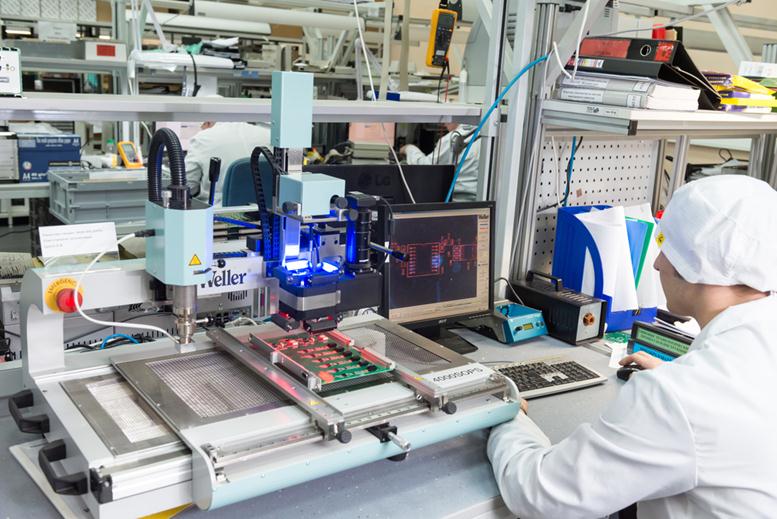
Forge Nano‘s (NASDAQ:NANO) strategy is deliberate. Its TEPHRA cluster tool and the single-module TEPHRA One, unveiled at SEMICON Taiwan in September 2025, sell into the 200mm market for MEMS, power electronics and photonics, where new entrants can win business and build a service footprint.15
The transaction proceeds fund a 300mm tool aimed at advanced memory and logic, “the exciting portion of the market that is going to be essential for the AI era.” 16
The global ALD market was estimated at $3.18 billion in 2025 and projected to reach $10.71 billion by 2035 by Precedence Research. 17
Forge Nano Holdings, Inc. (NASDAQ:NANO) management believes its addressable opportunity is larger than the existing ALD market because its tools can displace older CVD and PVD coating steps that conventional ALD was too slow to replace.18 Mordor Intelligence singled out Forge Nano‘s powder tool for “an unmatched throughput for particulate ALD.”19
The Battery Angle: Why Samsung SDI Put $20 Million Into a Colorado Company
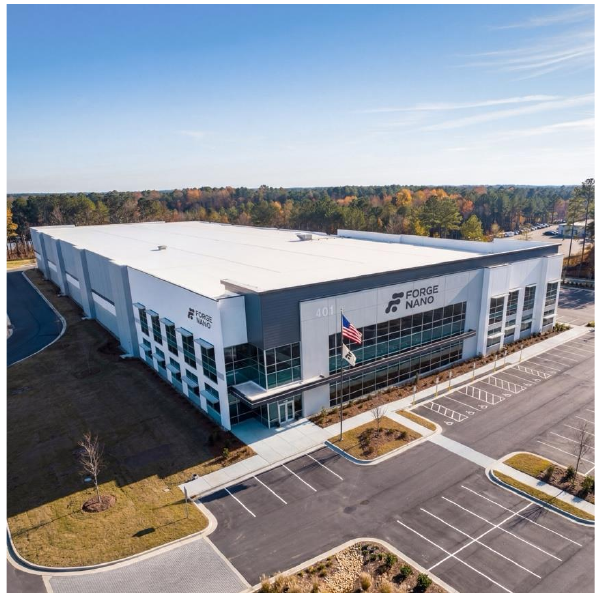 Forge Nano’s Morrisville, North Carolina facility, expanding to approximately 315,000 square feet. Source: Forge Nano investor presentation, August 19, 2026
Roughly a quarter of the lithium in a new battery is lost after the first charge cycle, trapped inside reactions on the electrode surface. Forge Nano Holdings, Inc. (NASDAQ:NANO)‘s Atomic Armor coats the cathode and anode so that lithium stays in play, which management says unlocks close to a 20% capacity gain from the same materials, along with faster charging, longer cycle life and a higher temperature threshold for thermal runaway.20 Nothing changes in the incoming supply chain or the outgoing manufacturing line. The coating drops in.
That is what makes Forge Nano different from other battery stories. It is not betting on a new chemistry. It makes proven cylindrical cells, 21700 and 18650 formats, better.
On June 25, 2026, Samsung SDI, one of the largest cell makers in the world, announced a strategic partnership to help build and ramp Forge Nano‘s (NASDAQ:NANO) 3 GWh plant in Morrisville, to have Samsung SDI cells manufactured there alongside Forge’s own, and to buy cells from the plant from 2028 under a conditional procurement agreement.
Forge Nano became Samsung SDI’s contract manufacturer and authorized US distributor, and the two companies are working to build Atomic Armor into future Samsung SDI products.21
Three weeks later Samsung SDI backed its Forge Nano Holdings, Inc. (NASDAQ:NANO) partnership with money: $20 million, split between Forge Nano’s Series D and the PIPE tied to its listing.23 The August 19 investor presentation puts it bluntly: “Samsung SDI guarantees operability, resolving the single biggest failure mode for U.S. battery startups.”24
The plant itself is financed by up to $100 million in non-dilutive funding from the US Department of Energy’s Office of Manufacturing and Energy Supply Chains under the Bipartisan Infrastructure Law toward its estimated $300 million to $330 million cost.25,26
Asked about the federal money at the groundbreaking, Lichty told WRAL: “We have been assured that the money will come in and I have no doubts about it.27″ Forge Nano Holdings, Inc. (NASDAQ:NANO) also lists $60 million in landlord tenant improvements and a $275 million project financing term sheet.28
Press Releases
- Forge Nano to Trade On Nasdaq as Nano After Completing Business Combination With Archimedes Tech Spac Partners II Co.
- Forge Nano and Nanexa Enter Joint Development Agreement to Advance Manufacturing for Ald-Coated Pharmashell® Long-Acting Injectable Medicines
- Forge Nano Expands Partnership With Battery AI Software Leader Voltaiq to Put AI at the Center of Battery Development and Manufacturing
- Nanometrics Combines IMPULSE+ Technology with 3D-NAND Interconnect Control
- What’s The Story On Nanometrics Incorporated?
America’s Battery Gigafactory Broke Ground on August 19
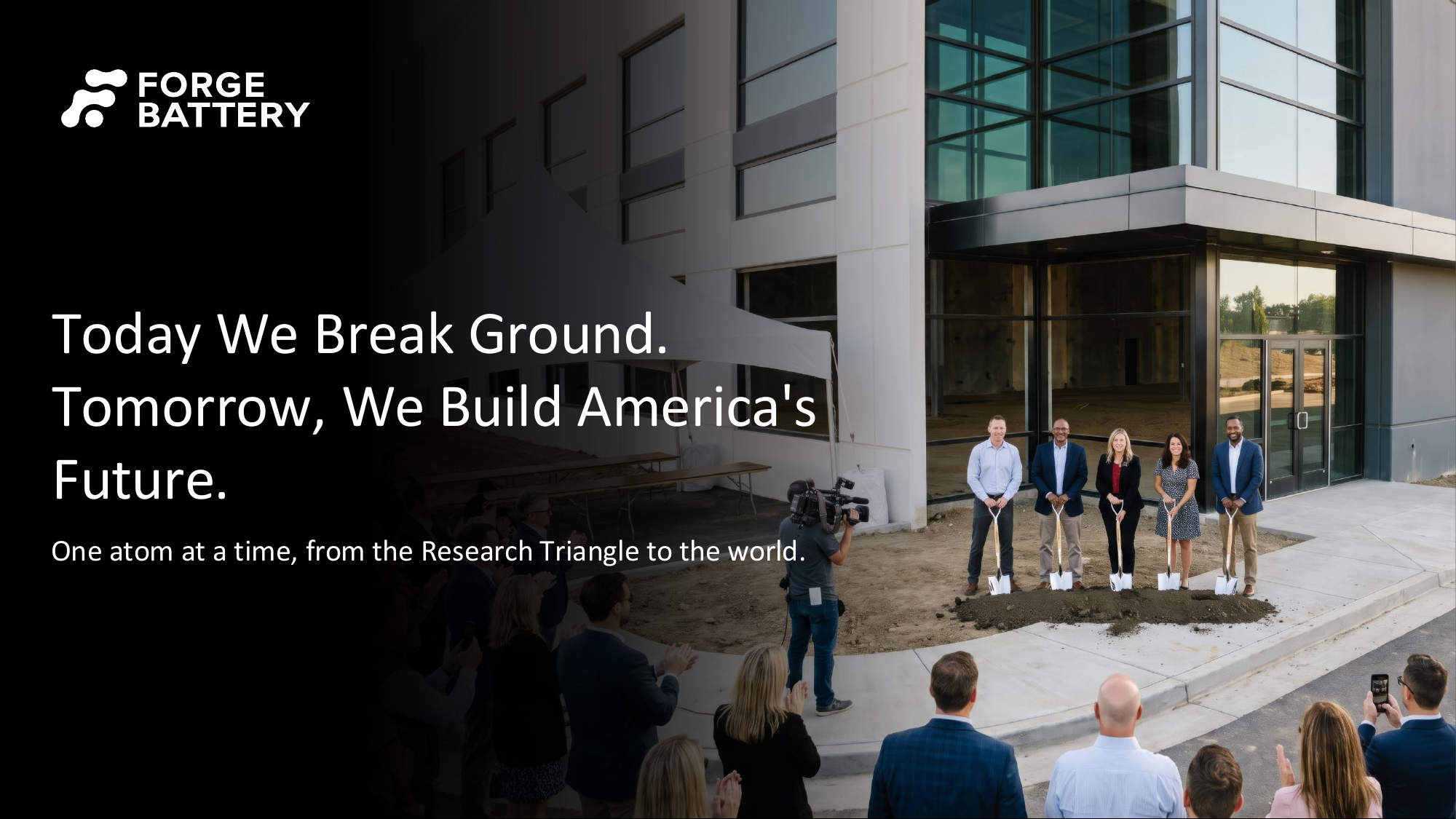
Senator Ted Budd, Representative Deborah Ross, Mayor TJ Cawley and DOE Assistant Secretary Audrey Robertson joined the Forge Nano leadership team
On August 19, 2026, Forge Nano Holdings, Inc. (NASDAQ:NANO) broke ground on the expansion that turns its 100,000-square-foot Morrisville operation into a campus approaching 315,000 square feet, with more than 250 jobs and about 3 GWh of annual capacity, roughly 150 million cells a year. Equipment arrives over the next two years and production is expected to begin in 2028.29
Scaling a gigafactory is a data problem as much as a construction one. On September 17, Forge Nano Holdings, Inc. (NASDAQ:NANO) expanded its longstanding partnership with Voltaiq, a leading battery AI platform, to embed AI and advanced analytics across its U.S. battery operations, from R&D through high-volume manufacturing and quality. For defense and aerospace customers, where quality and traceability are mandatory, Voltaiq’s tools are designed to help Forge Nano Holdings, Inc. (NASDAQ:NANO) engineers catch manufacturing anomalies, quality excursions and equipment issues as Morrisville ramps. “AI is becoming fundamental to how we operate,” said CEO Paul Lichty.
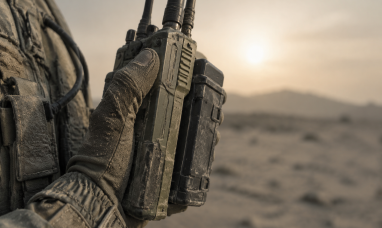
The company translated that capacity into the things the Pentagon is actually short of: about 10 to 20 million drone batteries a year, or 34,000 electric military vehicles, or 6 million BB-2590 radio batteries, depending on mix.30 Remember the Defense Innovation Unit’s number. Fewer than 200,000 drones ordered. An Army Secretary who has announced plans for at least one million.31 Forge Nano Holdings, Inc. (NASDAQ:NANO) is sized for the gap.
The Assistant Secretary of Energy put the federal view on the record at the ceremony: “These batteries will not only serve commercial markets, but also the defense and aerospace applications on which our military depends. That is exactly the kind of manufacturing capacity our country needs.”32
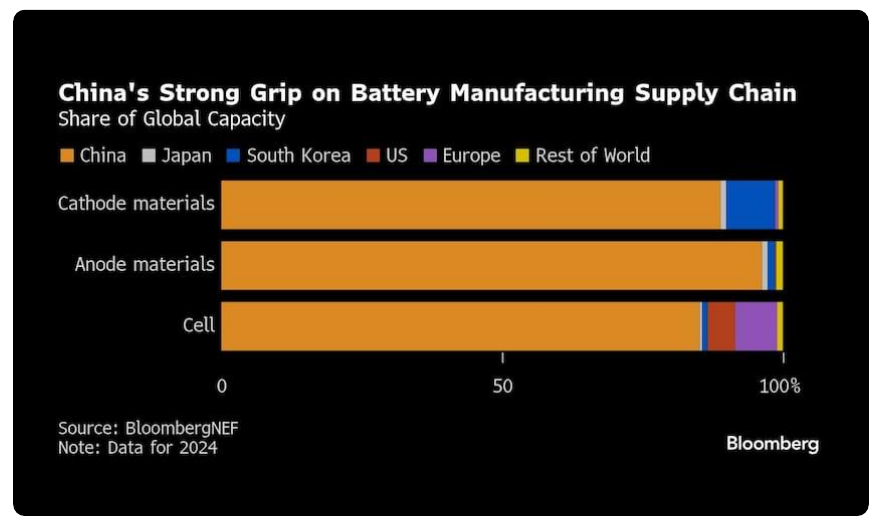
Note the detail most investors miss about Forge Nano, Inc.‘s (NASDAQ:NANO) position. Section 842 looks at who owns and processes the cathode, anode and cell, not just where the pack was assembled, with phase-ins for standard batteries in 2029 and existing programs in 2031.33 A Korean cell is not automatically compliant. A Samsung SDI cell built in North Carolina with a US-dominant supply chain, under a DOE-funded roof, is designed to be.
The Same Coating Is Already in Orbit
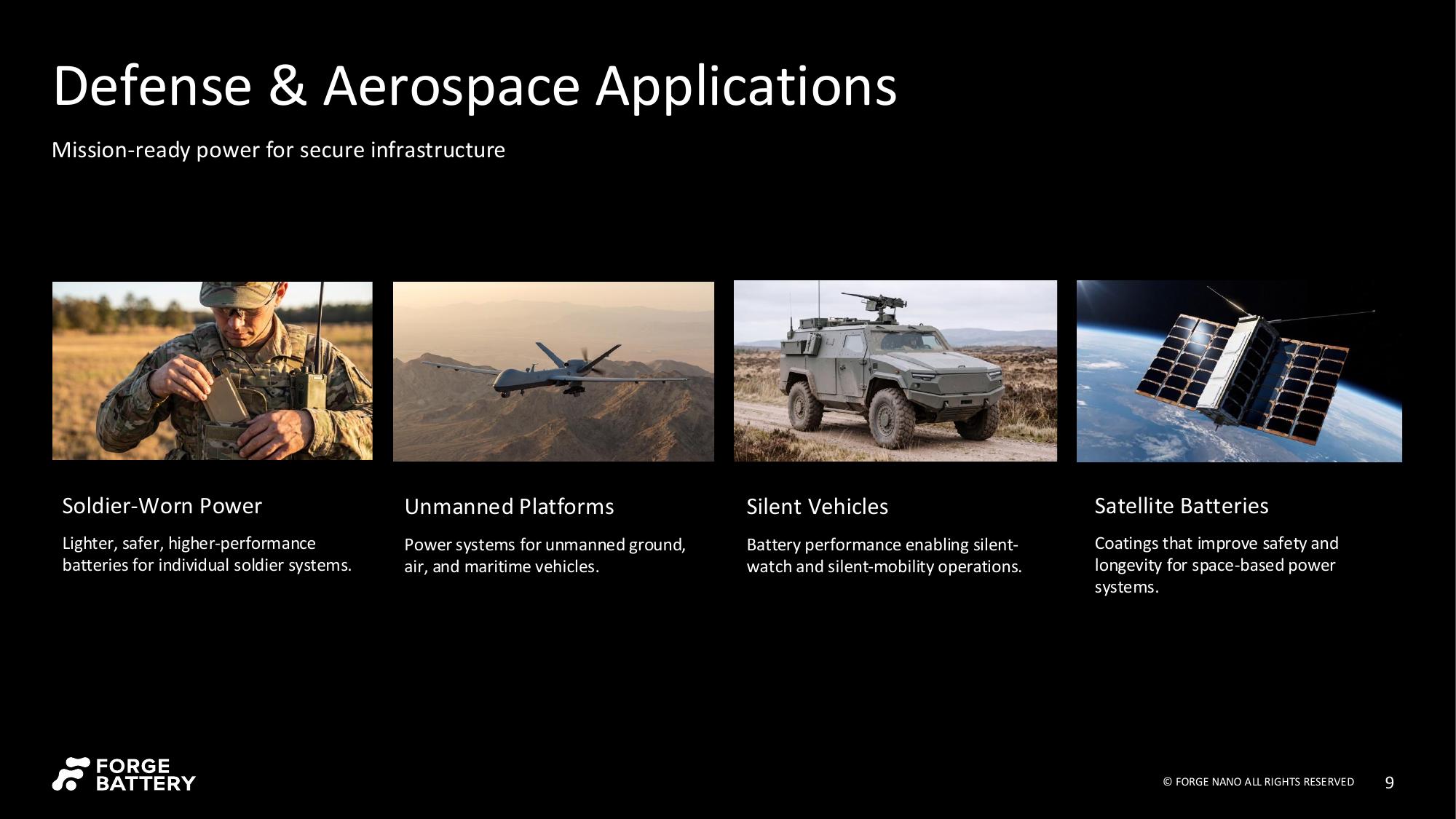
This is where the platform story separates Forge Nano Holdings, Inc. (NASDAQ:NANO) from other single-product comps. Atomic Armor cells have flown on Spire Global satellites launched aboard SpaceX missions, where thermal stability and reliability are non-negotiable.34 Lichty’s framing: “Space is one of the highest bars for materials performance, and we’ve cleared that.”
The same process has already been used to commercialize “the world’s first new solid-state rocket fuel,” and a coating partner is in Phase 2 clinical trials with time-controlled vaccines.
That pharma work is now becoming a manufacturing opportunity. On September 22, Forge Nano Holdings, Inc. (NASDAQ:NANO) signed a Joint Development Agreement with Swedish drug-delivery company Nanexa AB to develop large-scale, GMP-compliant ALD manufacturing equipment for Nanexa’s PharmaShell® platform, which uses nanoscale ALD coatings to create long-acting injectable medicines.35
Nanexa’s pipeline includes a license agreement with Moderna and NEX-22, a GLP-1 program that has shown preclinical and clinical proof of concept for a once-monthly formulation. Lichty said the deal shows the potential to apply Forge Nano’s ALD expertise to pharmaceutical manufacturing, where process control, repeatability and scalability are critical.
General Motors invested $10 million in 2024 and signed a partnership to use the company’s equipment on its cathode materials.36 Volkswagen led the Series A. Air Liquide and Mitsui Kinzoku, two of the largest industrial materials companies on earth, are shareholders.37,38
Here is the full map of where Forge Nano‘s (NASDAQ:NANO) one process is already at work or headed next.
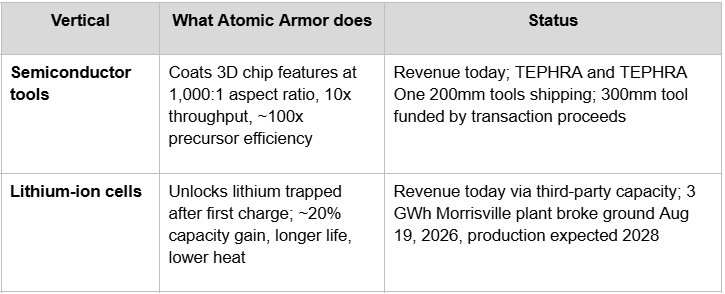
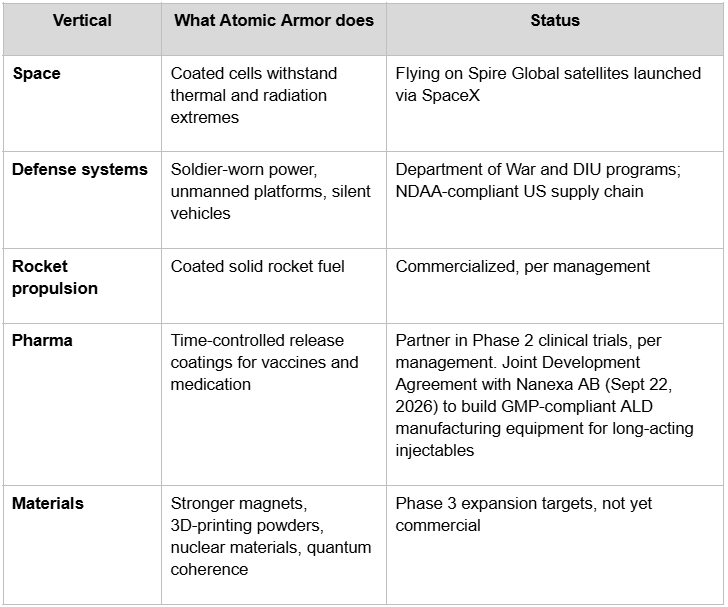
Forge Nano Holdings, Inc. (NASDAQ:NANO) management calls this Phase 3, “platform arbitrage,” and is explicit that it follows the scaling of the two core lines. But it is the reason Forge Nano is different from a battery startup or a niche tool vendor. One process, many doors.
How NANO Compares
The kindest thing to say about the battery stories of the last five years is that most of them ran out of road before their first gigafactory. The closest listed peer on the defense side is Amprius, which indicates the demand is real: it raised 2026 revenue guidance to at least $140 million on the strength of defense drone orders.39
But Amprius still contracts most of its cell manufacturing abroad, including in South Korea, and its Fremont site is primarily an R&D hub.40 Forge Nano Holdings, Inc. (NASDAQ:NANO) is preparing to build the cells in North Carolina with Samsung SDI beside it.
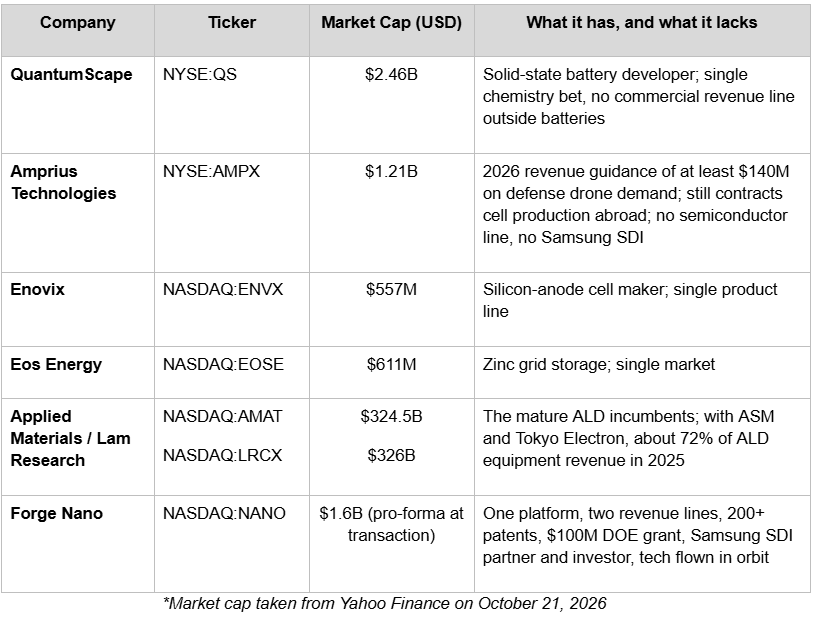
On the semiconductor side, the incumbents are enormous and well run. The point is not that Forge Nano Holdings, Inc. (NASDAQ:NANO) displaces them next year. It is that a company with roughly 200 patents41 and a capability the incumbents have not matched is entering the market at a fraction of their value, in the segment, 3D packaging, where the industry’s next constraint sits.
Newly Listed, With Real Money Behind It
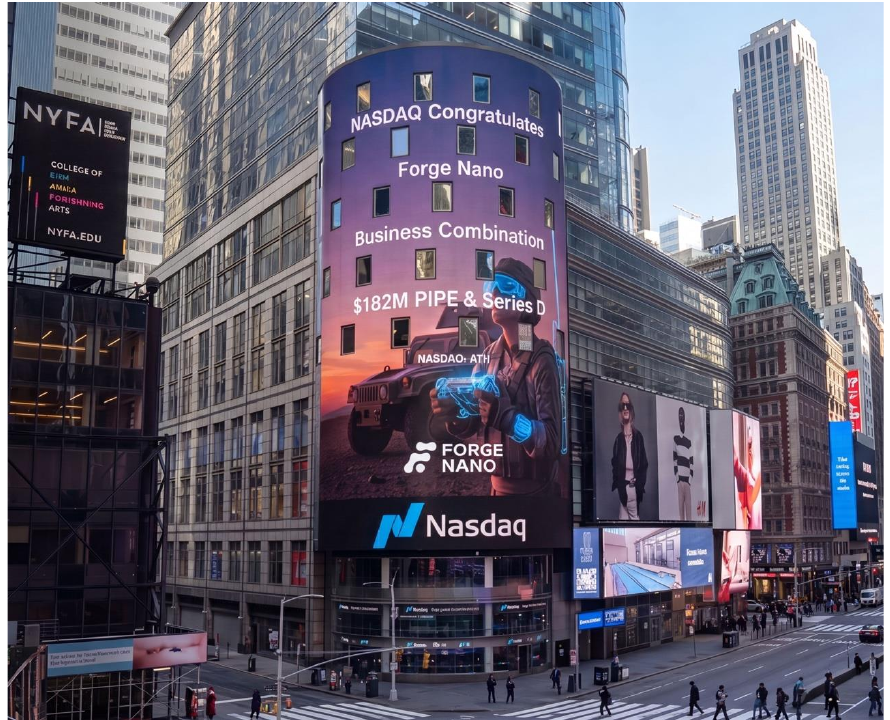
Forge Nano arrived on the Nasdaq with its capital formation already done. The PIPE tied to the listing totalled $123 million, with Samsung SDI and Horizons Ventures among the participants. The Series D closed at $97 million.
The deal valued Forge Nano Holdings, Inc. (NASDAQ:NANO) at $1.2 billion pre-money, with existing holders rolling 100% of their equity and retaining roughly 75% of the company. An earnout of up to $900 million vests over five years in one-third installments only if the share price reaches $15, $20 and $25, or trailing revenue reaches $400 million, $600 million and $800 million. Management is paid for execution, not for the listing.
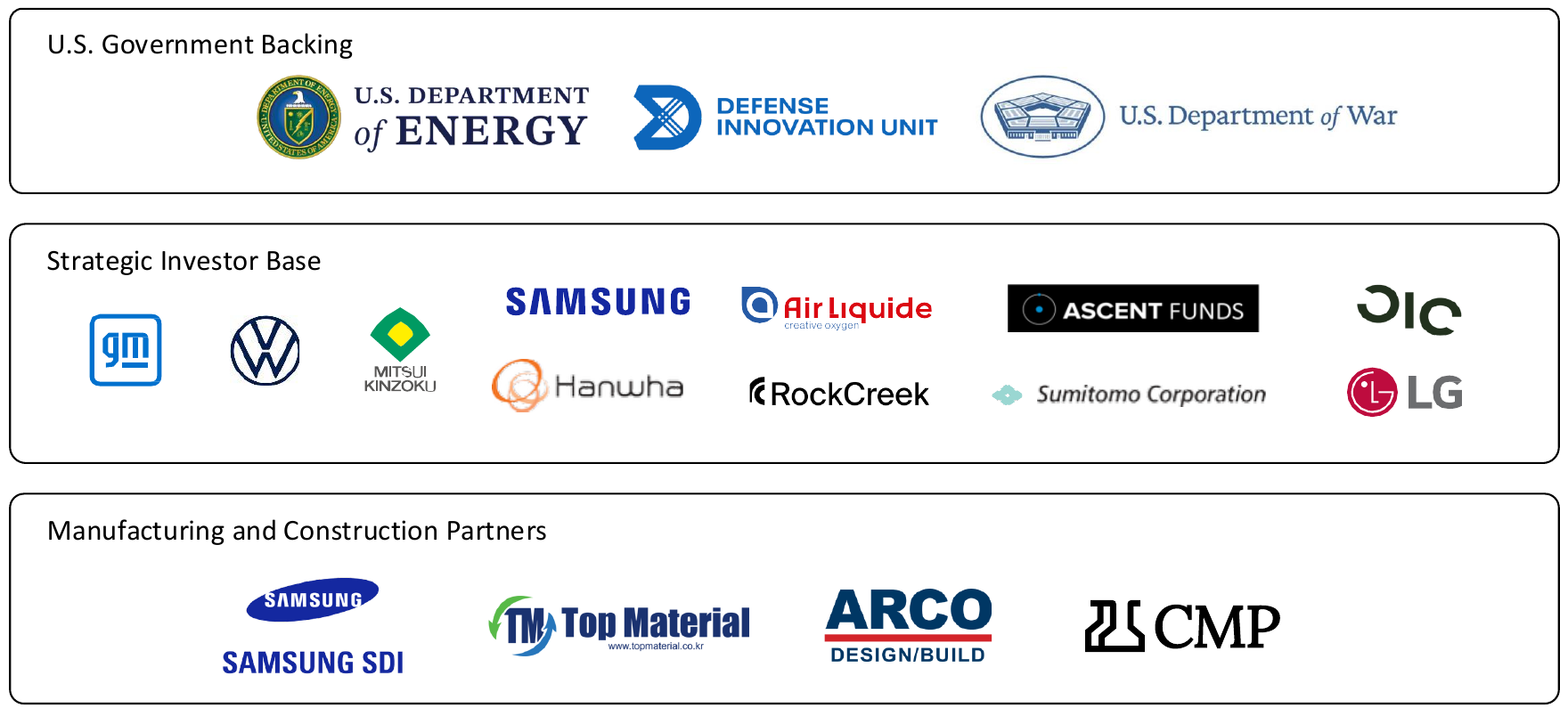
The investor roster reads like a supply chain: GM, Volkswagen, Samsung, LG, Hanwha, Mitsui Kinzoku, Sumitomo, Air Liquide, alongside financial backers RockCreek, OIC and Ascent Funds, and government support from the Department of Energy, the Defense Innovation Unit and the Department of War.42,43 Lichty bootstrapped the company for eight years before any of them wrote a check.
8 Reasons
to Put NANO on Your Watchlist
1
A platform, not a product. One coating process has already been validated in chips, cells, satellites, rocket fuel and a Phase 2 drug trial.
2
A legislated customer Section 842 bars foreign-entity-of-concern batteries from new Department of War contracts from January 1, 2028. Morrisville is timed to it.44,45
3
A Tier-1 partner who also invested. Samsung SDI helps build the plant, has cells made there, agreed to buy from it, and put in $20 million.46,47
4
$100 million the company does not pay back. DOE non-dilutive funding covers roughly a third of the gigafactory.48
5
A capability the AI incumbents lack Forge Nano Holdings, Inc. (NASDAQ:NANO) coats at 1,000:1 against a 10:1 standard, with 10x throughput, into a market with $1 trillion of fab investment ahead.49,50
6
Revenue now, growth mapped. $7.4 million in 2025
7
Fifteen years of operating history. Founded 2011, bootstrapped eight years, 200+ patents, 120+ employees, more than $100 million raised before the listing.51,52
8
Newly listed with an aligned earnout. Management earns its $900 million earnout in one-third installments only at $15, $20 and $25 a share or $400 million, $600 million to $800 million of revenue.
The People Behind NANO
What to Watch Next
Now: The DOE grant lands. The $100 million non-dilutive Department of Energy grant underpins the Morrisville build-out, but it hasn’t fully arrived yet. Asked about it directly at the groundbreaking, Lichty told WRAL: “We have been assured that the money will come in and I have no doubts about it.” That’s the company’s own CEO flagging this as unresolved — worth tracking as an open item, not a done deal.
Ongoing: The DoD 18650 test cell. In August 2025, Forge Nano announced it was developing a 100% US-sourced 18650 lithium-ion cell built specifically for Department of Defense testing. The cells were delivered for evaluation that year. Whether that testing converts into a qualification or follow-on order is a real, company-stated thread to watch — though no public timeline has been given for results.
Ongoing: Nanexa JDA milestones. Progress on the PharmaShell® manufacturing equipment is a test of whether Forge Nano‘s Phase 3 “platform arbitrage” can turn into real revenue beyond chips and cells.
November 10, 2026: China’s export-control suspension is expected to expire. Beijing’s one-year pause on export controls covering high-performance cells, cathode precursors, and graphite anodes ends this date. Whether controls resume shapes how much runway US manufacturers like Forge Nano have before competing against restricted Chinese supply again.
2026 to 2028: Morrisville is expected to come online. Equipment deliveries to the expanded facility are expected over the next two years, with production starting in 2028 — the same year Samsung SDI’s conditional procurement agreement kicks in.53,54
January 1, 2028: Section 842 takes effect. New Department of War contracts can no longer source advanced batteries, cells, or key components from a foreign entity of concern. This is the legislated deadline Forge Nano’s entire Morrisville timeline is built around.55
Ongoing: The semiconductor side scales in parallel. 300mm tool development continues, targeting the advanced memory and logic customers the battery story tends to overshadow. Watch 200mm TEPHRA bookings — that’s the nearer-term revenue proof point while Morrisville is still under construction.
The Bottom Line
Forge Nano Holdings, Inc. (NASDAQ:NANO) is a newly listed American manufacturing company built on one idea: if you can engineer the surface of a material atom by atom, and do it fast enough to be affordable, almost everything made from that material gets better.
The first two proofs are a semiconductor tool that coats what the incumbents cannot and a battery cell good enough for orbit. The next proof is a 3 GWh plant, funded by the Department of Energy and built with Samsung SDI, timed to a federal mandate that takes effect in 2028.
China wrote its export list. Congress wrote its deadline. The Pentagon said it needs these batteries yesterday. Forge Nano Holdings, Inc. (NASDAQ:NANO) broke ground on August 19.
Want to stay ahead of every Forge Nano Holdings, Inc. (NASDAQ:NANO) development as the Morrisville gigafactory rises and the 2028 mandate approaches?
Subscribe to the Trading Whisperer Newsletter to review the investor presentation and track every milestone as Forge Nano scales its Atomic Armor platform across chips, batteries and beyond.