The headlines argue politics. The capital is chasing rock.
On August 7, 2026, President Trump gathered his cabinet and America’s top mining executives at the White House and announced a wave of public financing for critical minerals: equity stakes, conditional loans, and partnerships, layered on top of a $12 billion national minerals stockpile modeled on the strategic petroleum reserve.1
This is not talk. Washington now owns pieces of mining companies. When the government took a 10% stake in Trilogy Metals to advance copper and cobalt exploration in Alaska, the stock rose roughly 240% in a single day.2 The Department of Energy took 5% of Lithium Americas.3 A White House official has called equity stakes in miners “the norm from our perspective.”4
And in November 2025, the US Interior Department did something it had never done before. It put copper and silver on the official Critical Minerals List, joining nickel, cobalt, palladium, and platinum.5
Read that list again. Copper. Nickel. Cobalt. Palladium. Platinum. Silver.
Every one of those metals sits in the drill core at the Nisk Project in Quebec, the flagship discovery of Power Metallic Mines Inc. (TSXV:PNPN) (OTCQB:PNPNF).
And at the Lion Zone, recent headline intervals have run from roughly 5% to 15% recovered copper equivalent, multiples above the 0.52% average copper grade globally according to S&P.
That is what makes this story different. Power Metallic Mines Inc. (TSXV:PNPN) (OTCQB:PNPNF) is not simply finding the metals governments want. It is finding them together, at exceptional grades, in one of the world’s safest mining jurisdictions. And as of September 8, 2026, an independent resource has put a number on it.
Ottawa is moving just as fast. Canada stood up a C$2 billion Critical Minerals Sovereign Fund to make equity investments, loan guarantees, and offtake agreements,6 with copper and nickel named among its first priorities.
At the G7, Prime Minister Carney announced a critical minerals alliance now catalysing $19.2 billion across 69 partnerships. 7
And on August 17, 2026, Carney stood beside Quebec’s premier and the CEO of Hydro-Quebec to announce up to $10 billion in federal support for clean power expansion explicitly tied to critical minerals development, billed as the largest clean energy investment in North American history.8
Two governments. Tens of billions of dollars. One shopping list. And Power Metallic Mines Inc. (TSXV:PNPN) (OTCQB:PNPNF) is sitting on a deposit that checks every box on it, in a G7 jurisdiction, with a Hydro-Quebec substation literally across the road.10
Keep reading, because the policy tailwind is only the third best part of this story.
Why the Smartest Way to Play the AI Boom May Be a Rock in Northern Quebec
You do not have to guess which AI model wins. You do not have to pay 40 times revenue for a data center stock. Every one of them, winners and losers alike, needs the same thing: staggering amounts of electricity, delivered through staggering amounts of copper.
The numbers are hard to believe until you see the sources.
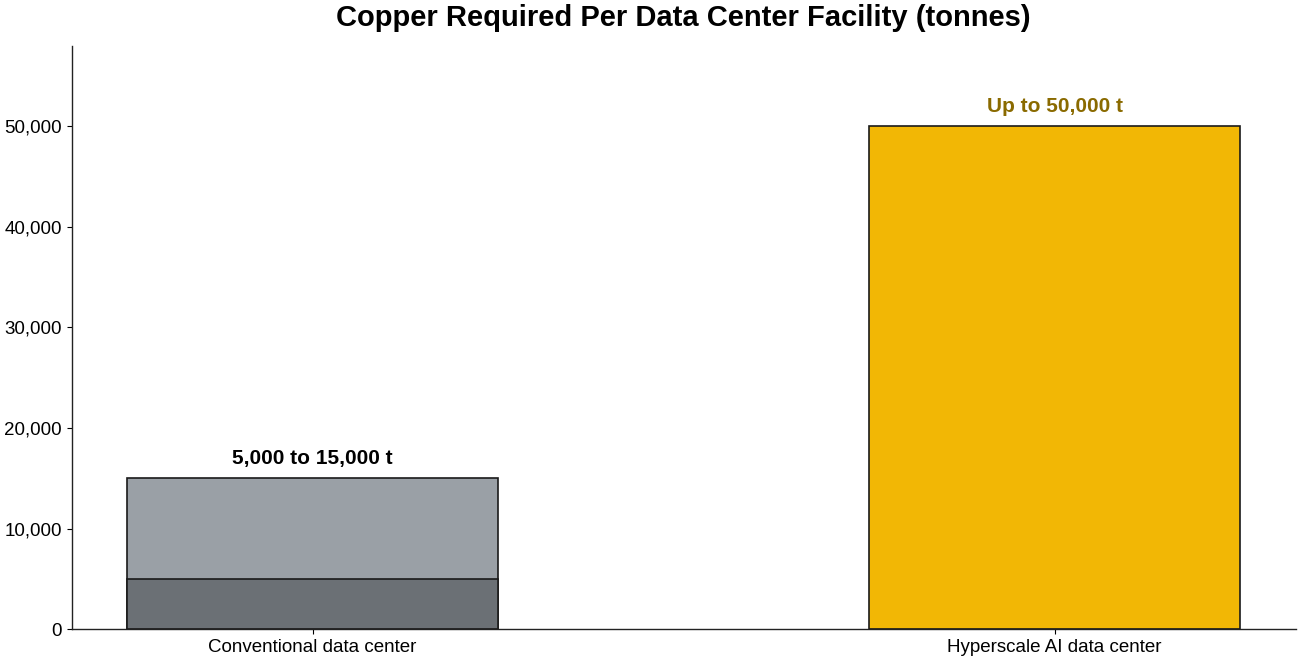
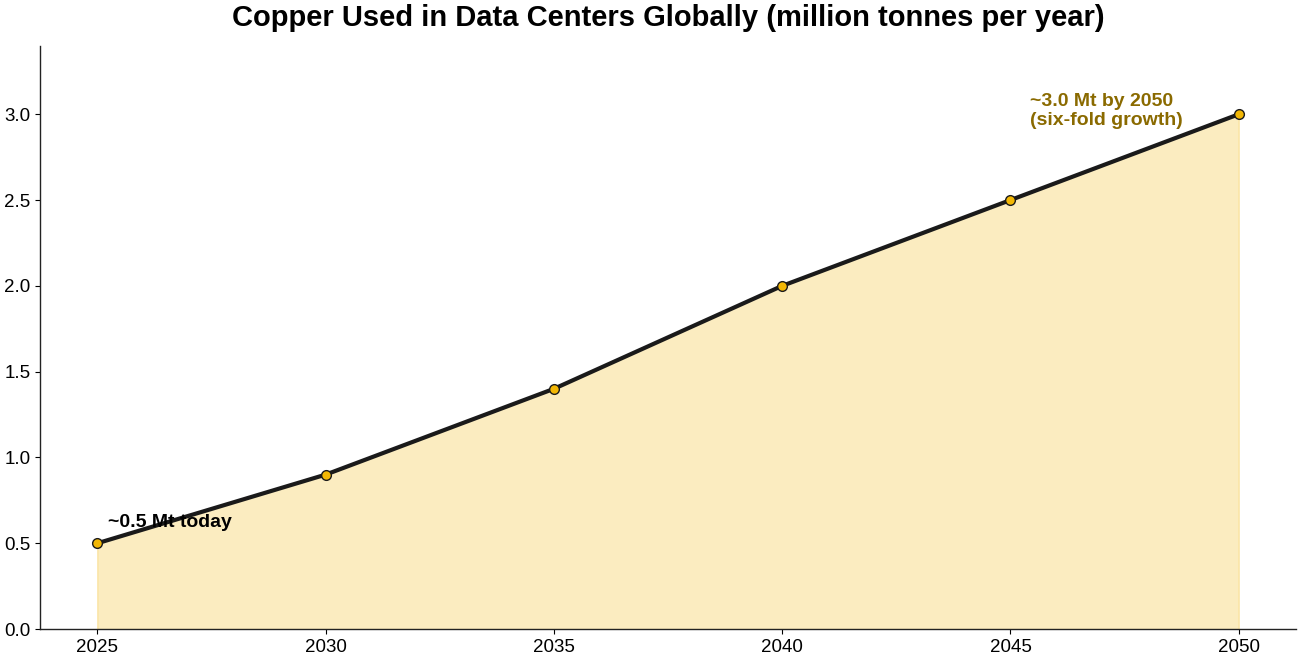
A conventional data center uses 5,000 to 15,000 tonnes of copper. A hyperscale AI data center can require up to 50,000 tonnes for a single facility, according to the Copper Development Association.10 BHP, the world’s largest miner, projects that copper used in data centers will grow six-fold by 2050, from around half a million tonnes a year to roughly 3 million tonnes, an increase about equal to the combined output of the world’s four largest copper mines.11
The International Energy Agency expects data center electricity demand to more than double to roughly 945 terawatt hours by 2030, with AI the single biggest driver, and puts data center copper demand at 512,000 tonnes by that year.12 Behind the data centers sits the grid itself: transmission lines, substations, transformers, all copper intensive, all being rebuilt at once.
Now look at supply. The International Copper Study Group flipped its 2026 forecast from a surplus of more than 200,000 tonnes to a deficit of around 150,000 tonnes.13 Goldman Sachs raised its 2026 refined copper deficit forecast outside the US more than tenfold, to 640,000 tonnes. 14
The IEA has warned the copper shortfall could reach 30% by 2035,15 while Wood Mackenzie sees demand surging 24% to nearly 43 million tonnes by then, requiring 8.2 million tonnes of brand new mine capacity.16
That new capacity is not coming easily. The average grade of the world’s copper mines has fallen roughly 40% since 1991,15 and Codelco, the world’s largest copper producer, has publicly admitted it cannot hit its own production targets.15 Copper traded above US$13,000 per tonne through mid 2026 and major banks see US$14,500 to US$15,000 ahead.17
Falling grades. Failing supply. Structural demand that does not care about the business cycle.
This is the setup Power Metallic Mines Inc. (TSXV:PNPN) (OTCQB:PNPNF) walks into holding a discovery with grades unlike anything else in the copper market, as the drill results below make plain.
Copper may be the headline, but the Lion Zone is a polymetallic system, and each metal riding alongside the copper has its own buyer, its own use case, and its own government designation as critical.
Copper Is the Headline. Platinum Could Be the Valuation Kicker.
Copper alone gives the Lion Zone a powerful macro setup. But copper is only part of what comes out of this rock.
Platinum may be the most overlooked piece of the story.
The World Platinum Investment Council expects 2026 to mark the fourth consecutive annual platinum deficit, with supply falling 297,000 ounces short of demand and above-ground stocks shrinking to less than three months of global consumption by year end.17
And now AI is adding another demand engine.
Beyond catalytic converters, glass, and chemicals, platinum is the essential catalyst in hydrogen fuel cells and electrolyzers, with hydrogen uses forecast to reach 875,000 to 900,000 ounces of annual demand by 2030.18
The WPIC has even flagged the AI connection directly, noting that nearly US$300 billion earmarked for AI infrastructure benefits platinum group metals through semiconductors, hard drives, circuit board glass, and fuel cell backup power for data centers.19
That matters because the platinum at Lion is not theoretical.
SGS locked-cycle testing recovered 96.8% of the platinum and 93.9% of the palladium, alongside an extraordinary 98.9% copper recovery, into a concentrate grading 25.8% copper.
And the maiden resource now puts ounces behind it. The Lion resource holds roughly 528,000 ounces of platinum and palladium, 72,000 ounces of gold, and about 1.9 million ounces of silver, sitting alongside roughly 177 million pounds of copper. 20
Think about what that means.
The same tonne of rock that gives Power Metallic its copper exposure can also deliver platinum, palladium, gold, silver, and nickel through the same conventional flotation process.
Palladium and nickel add another layer. Their near-term supply pictures may not be as tight as platinum’s, but both remain strategically important metals, both sit on the US Critical Minerals List, and nickel is a priority metal under Canada’s critical-minerals strategy. Inside a polymetallic system, they can become additional credits from the same ore if the project is ultimately developed.21
Silver adds exposure to electrification, solar, electronics, and defense. Gold adds the monetary-metal component.22
Here is why the mix matters financially. SGS testing showed that Lion’s modeled recovered metal value splits almost evenly between base and precious metals, with roughly 49% coming from copper and nickel and 51% from platinum, palladium, gold, and silver.
That creates built-in diversification: copper carries the industrial demand story, platinum, gold, and silver add scarcity and precious-metals exposure, and Power Metallic Mines Inc. (TSXV:PNPN) (OTCQB:PNPNF) gets exposure to both sides from the same tonne of rock through the same conventional flotation circuit.23
One deposit. One processing circuit. Multiple critical and precious metals in every tonne.
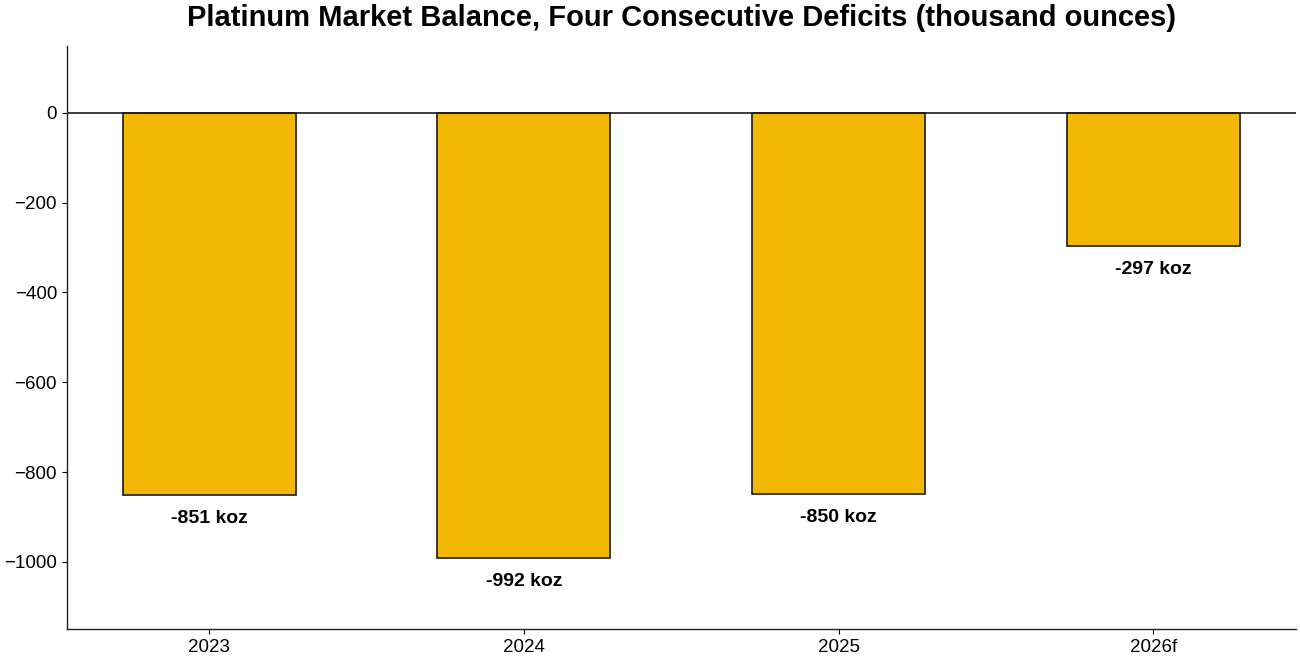
Four consecutive platinum deficits have drawn stocks below three months of demand cover. Chart by the author from World Platinum Investment Council data.47
Press Releases
- Power Metallic Extends Lion 25% Deeper as Power Metallic Intercepts 5.70 Meters of 14.00% CuEqRec¹ in Hole 26-125
- Power Metallic Defines High-Grade Maiden Resource at Lion Averaging ~3.9% CuEq, with >85% Indicated and Significant Expansion Potential
- Power Metallic Provides NISK update
- Power Metallic reports New Lion drill intercepts of 36.42 Meters of 2.83% CuEqRec1 in Hole 26-116 including 6.00 Meters of 12.38% CuEqRec1 and Announces AGSM Meeting Results
- Power Metallic Announces Appointment of Christopher Beal as Vice President of Operations
8 Reasons
Power Metallic Mines Belongs on Your Watchlist Before Q4 2026
1
A Maiden Resource, Banked: On September 8, 2026, SGS Canada delivered the inaugural NI 43-101 resource on Lion: 4.75 million tonnes grading close to 4% CuEq, roughly 406 million pounds of contained copper equivalent, more than 85% in the Indicated category, starting at surface, and open at depth. The Preliminary Economic Assessment is being scoped now.
2
Grades That Lead the Industry: Recent intercepts include 16.55 metres of 15.11% CuEqRec, the best copper intersection in company history, and 22.00 metres of 11.46% CuEqRec.24
3
Metallurgy That Beat Expectations: SGS locked-cycle testing returned recoveries of 98.9% copper, 96.8% platinum, and 93.9% palladium into a 25.8% copper concentrate.25
4
Billionaires on the Register: Robert Friedland, Rob McEwen, Gina Rinehart, and Eric Sprott are all shareholders, and key shareholders own about half the company.26
5
Analyst Coverage With Upside: Hannam & Partners raised its target 13% to C$2.70 the day the resource landed, implying 78% upside, and its analysis suggests the project could be built for under US$200 million with a payback of about one year. Roth MKM carries a Buy rating and a C$3.00 target.27
6
Funded Through the Catalysts: A C$50 million financing in 202528 and a $28 million raise in June 2026 fund a 100,000 metre drill program with five rigs turning.29
7
Policy Tailwinds From Two Capitals: Every metal in the deposit is on the US Critical Minerals List, and copper and nickel head the priority list for Canada’s new C$2 billion sovereign fund.
8
A Proven Wealth-Building District: The James Bay region already turned one junior’s discovery into a US$420 million takeover and a top ten Canadian mine.30
The Number Is In. The Floor Is Set. The Ceiling Is Not.
On September 8, 2026, SGS Canada delivered the inaugural NI 43-101 resource on Lion for Power Metallic Mines Inc. (TSXV:PNPN) (OTCQB:PNPNF): 4.145 million tonnes Indicated at 3.86% CuEq plus 0.601 million tonnes Inferred at 4.01% CuEq. Call it 4.75 million tonnes at close to 4% CuEq, roughly 406 million pounds of contained copper equivalent, more than seven times the grade of the average copper mine on Earth. Nisk Main was restated alongside it at roughly 4.7 million tonnes at 2.6% CuEq.31
Three details matter more than the headline. More than 85% of Lion is already Indicated, the category that can feed a mine plan. Mineralization starts at surface, with about 59% of the tonnes inside an open-pit resource, which is why Lynch says Lion “has the potential to be developed with a relatively modest initial footprint and capital requirement.” And the resource counts only drilling completed to April 19, 2026. Everything drilled since then is not in it.
Hannam & Partners did not wait. The day the resource landed, the firm raised its target 13% to C$2.70, implying 78% upside.32 Its provisional model on a combined open-pit and underground operation at Lion-Nisk shows a base case NPV of US$309 million at a 47% internal rate of return, and an upside case of US$840 million at 71%. In plain terms, the first independent economics say Power Metallic Mines Inc. (TSXV:PNPN) (OTCQB:PNPNF) has a viable mine, and they only model what is already in the resource.
Which brings us to what the market has not seen yet. The deepest hole in the modelled shoot, PML-25-002, cut 7.95% CuEqRec at about 610 metres vertical depth. Three holes completed after the cut-off, PML-26-121A, PML-26-125 and PML-26-128A, went below the modelled zone and intersected visible copper mineralization.
Assays are due by the end of September. Shoots of this type run deep. In the Sudbury camp, Creighton has been mined to 2.4 kilometres and Onaping Depth reached ore near 2,600 metres. Lion has been modelled to 600. And the nickel-rich sulphide that forms first in these systems has, in Lynch’s words, not been found yet.
The resource raised the floor. The deep holes are the first glimpse of the ceiling.
The Drill Hole That Turned a Quiet Junior Into the Top Mining Stock in Canada
Every great mining story has a moment. For Power Metallic Mines Inc. (TSXV:PNPN) (OTCQB:PNPNF) it came in May 2023, on a never-before-drilled target the geologists called Wildcat, five kilometres northeast of the company’s Nisk nickel deposit near Nemaska, Quebec.
Hole PN-23-031A returned 7.75 metres carrying a combined ounce per tonne of platinum and palladium, along with copper, gold, and silver.33
“Wow, what a hole,” CEO Terry Lynch said in the release announcing it. The Wildcat target became the Lion Zone, and the Lion Zone changed everything.
Through 2024, step-out after step-out hit thick, high-grade polymetallic mineralization. The market noticed. The stock appreciated 365% that year, earning Power Metallic Mines Inc. (TSXV:PNPN) (OTCQB:PNPNF) recognition on the 2024 TSX Venture 50 as the number one ranked mining company on the entire exchange, and fourth overall among more than 1,600 issuers.34
Then the company did what few juniors have the discipline to do. It consolidated the district. In June 2025, it acquired 167 square kilometres of adjoining claims from Li-FT Power, expanding its land position by 600%, 300% from Li-FT and 300% from staking, and securing roughly 50 kilometres of prospective basin margins that envelope the Nisk, Lion, and Tiger discoveries.35 Today Power Metallic controls approximately 330 square kilometres of the most prospective ground in the camp.36
So, what has all that ground been producing?
Grades that sound made up until you read the lab certificates. Most of the world’s copper mines operate below 0.52% copper.37
Hold that number in your head while you read what Power Metallic Mines Inc. (TSXV:PNPN) (OTCQB:PNPNF) has pulled out of the ground at Lion in 2026 alone, every figure taken directly from the company’s press releases and verified by an independent ISO-certified laboratory.38
-
-
- 16.55 metres of 15.11% CuEqRec, including 10.08% straight copper, in hole PML-26-049. The best copper intersection in the company’s history, near surface, in a zone that may be amenable to open pit mining.39
- 22.00 metres of 11.46% CuEqRec in hole PML-26-095, including 6.50 metres of 18.59% CuEqRec, the second best intersection ever at Lion.40
- 17.45 metres of 9.47% CuEqRec in hole PML-26-094, including 6.30 metres of 17.91% CuEqRec.41
- 39.00 metres of 5.66% CuEqRec in hole PML-26-101, including 9.20 metres of 15.18% CuEqRec, high grade over an exceptionally wide intersection.42
- 36.42 metres of 2.83% CuEqRec in hole PML-26-116, including 6.00 metres of 12.38% CuEqRec, in the final assays feeding the resource estimate.43
-
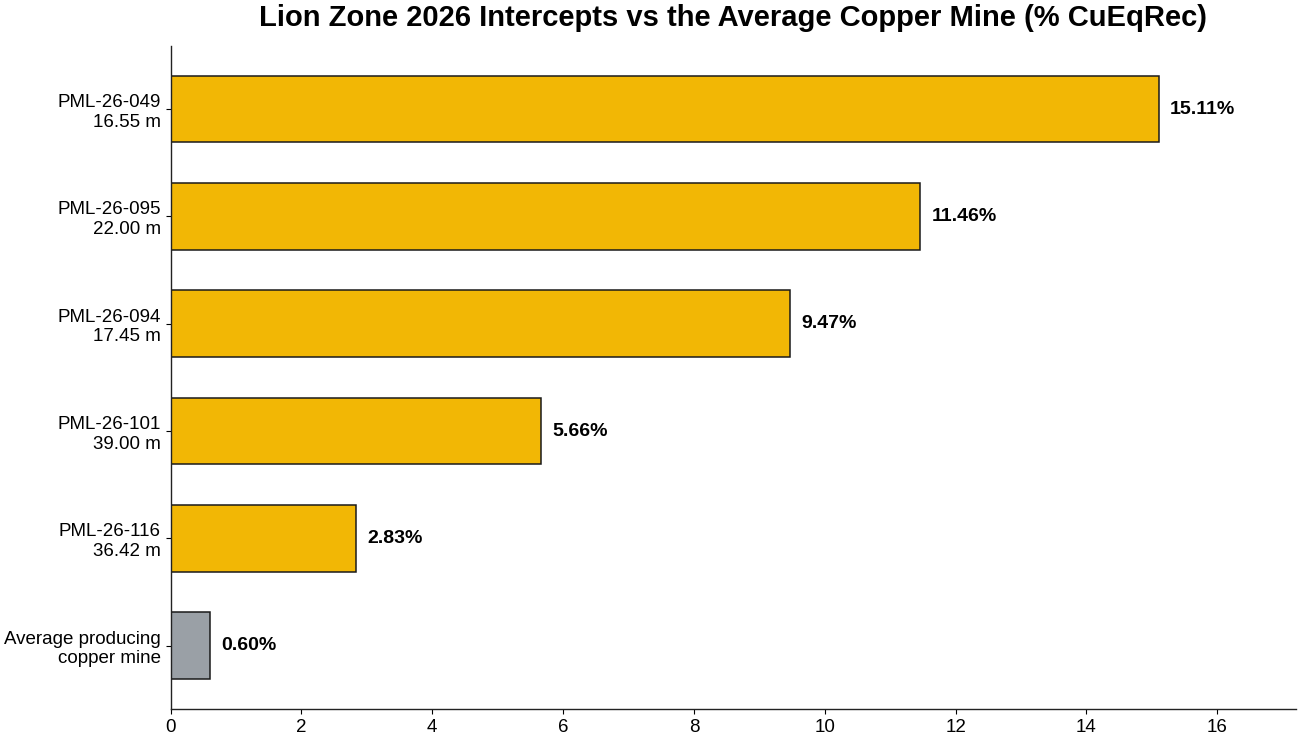
Three of the top five holes in company history arrived in the month of May 2026 alone.44 These are not isolated lucky hits. The company reports more than 100 intersections of at least 11 metres grading better than 4.24% CuEq, high grade from top to bottom of the zone.45
And the zone is still open. Lion has been traced roughly 700 metres down plunge, sits 5.5 kilometres along trend from the Nisk deposit, and the Tiger discovery lies another 700 metres beyond Lion. CEO Terry Lynch describes the strategy simply: push Lion toward development while finding more Lions.46
Recoveries Near 99%, Economics Built on Grade, and a Deposit Family Found Once a Generation
High grades in the ground mean nothing if you cannot recover the metal. In January 2026, SGS Canada, the world’s leading testing and certification firm, delivered the answer.
A locked-cycle test on a blended composite designed to represent run-of-mine feed produced a clean sulphide concentrate grading 25.8% copper, with recoveries of 98.9% for copper, 96.8% for platinum, 93.9% for palladium, 88.9% for silver, and 85.0% for gold.21
A second test in May 2026 on low-grade disseminated material returned 98.3% copper recovery into a 25.4% copper concentrate. That result mattered for the resource, because it proved even the lower-grade halo around the high-grade core responds to conventional flotation and could be counted.
Here is the detail sophisticated investors will love. Before these tests, Power Metallic Mines Inc. (TSXV:PNPN) (OTCQB:PNPNF) had been calculating its copper-equivalent grades using an assumed 80% recovery for every metal, consistent with peers. The real recoveries came in so far above that assumption that every previously published CuEqRec figure had understated the deposit. The company now uses the actual SGS recoveries, and the restatement moved the numbers up, not down.47
SGS went further, noting the concentrate opens potential opportunities for value-added products serving battery storage, electrification, clean energy, and advanced manufacturing.48 Simple flotation. A premium concentrate. Nearly every dollar of metal in the rock recovered into it.
Now connect those recoveries to money, because grade is what separates mining fortunes from mining disappointments. A typical low-grade copper porphyry runs 0.4% to 0.7% copper and can demand $20,000 to $30,000 of capital per tonne of annual production, for typical returns of 15% to 25% at $4 copper. High-grade projects above 1% cut that capital intensity dramatically and push returns above 30%. Ultra-high-grade systems in the class the company believes Lion belongs to, above 5% CuEq, can drive capital intensity to roughly $10,000 or less.49
The logic is brutally simple. When every tonne you process carries five to fifteen times the metal of the average mine, you need a smaller mill, less power, less tailings capacity, and less capital to produce the same copper. Margins widen at any price. In a downturn, the high-grade mine is the last one standing. In a bull market, it prints.
That is why the upcoming economic studies matter so much for Power Metallic Mines Inc. (TSXV:PNPN) (OTCQB:PNPNF). The grades are published. The recoveries are proven. The resource is now independently defined. The Preliminary Economic Assessment being scoped right now is where those facts turn into projected returns, and the raw inputs here are the kind that produce numbers most projects can only dream about.
There is one more layer to the economics and it is geological. The Lion Zone is not a typical copper deposit. It belongs to the orthomagmatic nickel-copper-PGE family, the rarest and among the most valuable deposit types on Earth. The family includes Voisey’s Bay in Labrador, Anglo American’s Sakatti discovery in Finland, and the patriarch of them all, Norilsk in Russia, one of the only mining complexes in history with more than $1 trillion of metals produced or in reserves.
Sakatti, found in 2007, was the last major discovery in this family before Lion. That is an eighteen-year gap.50 These systems are compact, extraordinarily rich, and polymetallic by nature, which is why they become the most profitable mines in the world when developed.
And unlike Norilsk’s Arctic Siberia or Sakatti’s protected Finnish wetlands, this one sits beside a highway, a hydroelectric substation, and a workforce in one of the world’s premier mining jurisdictions, with Quebec and Canadian tax credits covering as much as 50% of exploration and development costs.
Geologists at Power Metallic Mines Inc. (TSXV:PNPN) (OTCQB:PNPNF) did not stumble into this classification. Board member Dr. Steve Beresford, one of the world’s foremost polymetallic specialists, helped define it, and the company’s exploration model treats the entire 330 square kilometre basin as a district capable of hosting multiple deposits of the family.51
The Resource Today and the Number That Could Reset Everything Before Labor Day
Here is what is already banked. The Nisk deposit carries an initial NI 43-101 resource of 5.43 million indicated tonnes grading 1.05% NiEq plus 1.79 million inferred tonnes at 1.35% NiEq, published in 2023 before the Lion discovery was ever counted.53
The Lion Zone itself has never had a compliant resource. Independent analysts covering the company, including GBC, Hannam Partners, Noble Capital, Red Cloud, and Roth, have published estimates ranging from 7.0 to 16.5 million tonnes and 4.25% to 7.0% CuEq.54 Those third-party estimates are not NI 43-101 compliant mineral resources and the company does not endorse them, but they frame what the market is waiting to see verified.
And the MRE could unlock something even more important: a NAV the market can value the company against.
Leading copper development companies can trade at roughly 0.4 to 1.1 times projected NAV, with the highest multiples generally awarded to projects with clearer paths to development and stronger projected economics.
Power Metallic Mines Inc. (TSXV:PNPN) (OTCQB:PNPNF) does not have that NAV estimate yet. But once the MRE establishes Lion and Nisk’s size and grade, analysts can begin modeling what the project could ultimately be worth.
If post-MRE analyst estimates ultimately put Nisk-Lion near US$1 billion of NAV, Power Metallic‘s roughly US$200 million-plus market capitalization would imply a valuation of only about 0.2 times NAV.
That is the potential re-rating setup.
The MRE establishes the resource. The PEA that follows puts economics around it. And Lion already brings exceptional grades, near-99% copper recoveries, strong PGE recoveries, near-surface mineralization, road access, and low-cost Quebec hydro power.
The missing pieces are independently defined scale and economics.
On July 30, 2026, Power Metallic Mines Inc. (TSXV:PNPN) (OTCQB:PNPNF) confirmed that the maiden combined Mineral Resource Estimate on Nisk and Lion is expected before Labor Day, with the PEA to begin immediately after.55
CEO Terry Lynch has described the MRE as the independent proof needed to move Lion from spectacular drill results to a quantified asset the market can underwrite.
Until now, investors have been valuing drill holes. After the MRE, they can start valuing a project.
Follow the Money Because the Legends of Mining Are Already Here
Robert Friedland built Ivanhoe Mines into a colossus. Rob McEwen founded Goldcorp. Gina Rinehart is the richest person in Australia on the strength of iron ore. Eric Sprott is the most famous resource financier Canada has ever produced.
All four are shareholders of Power Metallic Mines Inc. (TSXV:PNPN) (OTCQB:PNPNF). And this is not a one-time punt.
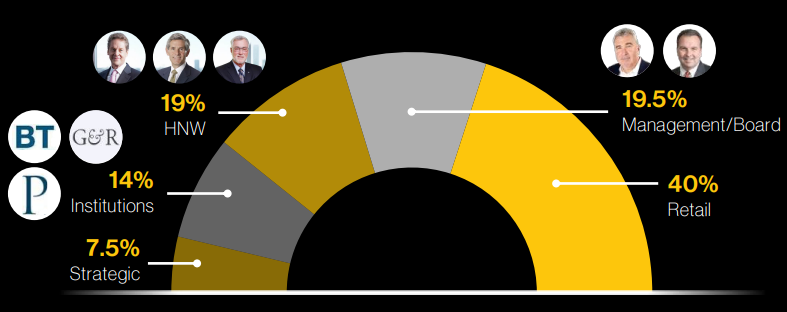
As CEO Terry Lynch put it publicly in July 2026: “Robert Friedland has been in for three years. Rob McEwen and Gina Rinehart too. We just added Eric Sprott in our most recent close. I’ve been the second biggest investor myself over that stretch. Key shareholders now own about half the company.”56
Management and board hold 19.5% of the register, high-net-worth investors 19%, and institutions 14%.57 When roughly half a company is held by insiders and committed strategic money heading into its biggest catalyst, the float that trades is thin, and thin floats move fast on news.
There is a coiled-spring quality to the setup as well. Since the company’s February 2025 financing, the metals in the Lion Zone have surged: platinum up 82%, silver up 118%, gold up 48%, copper up 42%, and palladium up 43% as of June 2026, a weighted gain of 54.6% across the deposit’s estimated value mix.58 The share price has not remotely kept pace with the value of what is in the ground. Either the metals are wrong, or the stock is.
The professional analysts have taken a position too. Roth MKM’s Mike Niehuser reiterated his coverage on Power Metallic Mines Inc. (TSXV:PNPN) (OTCQB:PNPNF) June 2026,59 and Hannam & Partners raised its target the same day the resource was published. Lynch himself is on record calling the stock “a super bargain” at current levels.60
So who is the man the legends keep backing? Terry Lynch is one of the most connected men in Canadian mining, and he earned it the unusual way: by fighting for shareholders.
In 2019 he founded Save Canadian Mining, the advocacy organization battling predatory and naked short selling in the junior markets. It is supported by the TSX Venture Exchange itself, the Ontario Mining Association, the Ontario Prospectors Association, over 25 junior miners, more than 5,000 individual members, and industry titans including Eric Sprott, Sean Roosen, Keith Neumeyer, and Rob McEwen.

Notice those last names. The same legends who back his advocacy back his company with their own capital. Lynch sits on the board of PDAC, mining’s leading industry association, is a member of the Trilateral Commission, has taken three companies public across a 30-year career, and co-founded Cardiol Therapeutics, which he helped take to the NASDAQ. He is also, by his own account, the second largest investor in Power Metallic Mines Inc. (TSXV:PNPN) (OTCQB:PNPNF) over the past three years.61 His interests and yours are the same interests.
Around him, Lynch has assembled a bench built for the next phase:
-
-
- Dr. Steve Beresford, Director. Former VP Exploration at First Quantum and MMG and Chief Geoscientist at IGO, one of the world’s leading authorities on exactly this deposit family
- Joe Campbell, P.Geo, VP Exploration. Forty years in the field, including senior roles on the Meliadine gold project now operated by Agnico Eagle, and the Qualified Person behind the company’s technical disclosure
- Seamus O’Regan, Director. Canada’s former Minister of Energy and Natural Resources, the man who led the country’s Critical Minerals Plan, now helping the company navigate the exact policy wave described at the top of this page
- Christopher Beal, VP Operations. Appointed June 2026 after building mining-technology firm NextOre from zero to a $131 million valuation.62 Lynch calls him “the guy who can build a mine for us,” with direct responsibility for the PEA and the feasibility work beyond it
-
Companies do not hire mine builders unless they believe they have a mine to build.
A District That Has Minted Fortunes Before and a Peer Group That Keeps Getting Bought
The Eeyou Istchee James Bay territory has done this before. In 2004 a junior called Virginia Gold Mines drilled the Eleonore discovery. Goldcorp bought it in 2005 for US$420 million plus a sliding royalty, and Eleonore became one of the ten largest producing mines in Canada.63 One discovery hole to a nine-figure exit to a generational mine. That is the district’s template, on the same infrastructure spine Power Metallic occupies today.
The former Virginia shareholders are still collecting a production royalty on Eleonore that floats with the gold price, two decades after the deal.64 That is what a discovery in this district can become. And the practical advantages that made Eleonore work are even stronger at Nisk: you can drive to site from the highway, low-cost Hydro-Quebec power sits across the road, Quebec and Canadian tax credits cover as much as 50% of exploration and development costs, and the company works alongside supportive First Nations partners in one of the most stable mining jurisdictions on the planet.34
The resource release named the programs: a 30% refundable federal credit on eligible mine equipment, a Quebec credit of up to 45% on critical-minerals development spending, and new C$2.5 billion Quebec and C$2 billion federal critical minerals funds. Lynch says the company may qualify for several of them.
The polymetallic peer group tells the same story with bigger numbers. Foran Mining’s McIlvenna Bay, a 29.7 million tonne copper-zinc resource at 2.5% CuEq, was acquired by Eldorado Gold in April 2026 for roughly C$3.8 billion.44 Adriatic Metals and its Vares polymetallic mine went to Dundee Precious Metals in a deal that valued the company at US$1.3 billion.65 This deposit class does not stay independent. It gets bought.
Run your eye down the grade column. Every company above Power Metallic on market cap carries a fraction of Lion’s grade. The market paid C$3.8 billion for 2.5% CuEq rock at McIlvenna Bay. A system now independently verified at close to 4% CuEq, with 98.5% copper recovery, starting at surface and open at depth, trades at a few hundred million.66
None of that history matters if a junior runs out of money before its moment, and junior mining’s oldest trap is good news arriving with a financing stapled to it. Power Metallic Mines Inc. (TSXV:PNPN) (OTCQB:PNPNF) cleared the decks deliberately. A C$50 million placement in February 2025, co-led by BMO Capital Markets and Hannam & Partners with flow-through stock priced at C$2.83, was followed by a $28 million raise at roughly $1.25 in June 2026.
“We didn’t want the market to have the financing overhanging,” Lynch explained. “Now the good news can just come out.”67 The treasury funds a 100,000 metre drill program, with five rigs turning today and roughly 40,000 metres still ahead between June and year end. Fresh assays from the summer program are expected from September onward, meaning the newsflow keeps arriving through the fall.
The company has 259.2 million shares outstanding and 303.9 million fully diluted, with a 52-week range of $0.76 to $1.73.68
The Catalyst Calendar Between Now and Year End Reads Like a Countdown
-
-
- September 8, 2026, delivered: Maiden resource on Lion, 4.75 million tonnes at close to 4% CuEq, more than 85% Indicated, plus an updated Nisk resource.
- By the end of September: Lion Deep assays from holes drilled hundreds of metres below the current resource, plus the first summer-program results from five rigs, including new regional targets across the expanded district.
- Within 45 days: The NI 43-101 technical report filed on SEDAR+, the final document required for the company’s Nasdaq application.
- October: The company expects to update on its Nasdaq listing through an ADR structure that does not require a share consolidation, following shareholder approval of US exchange-ready governance changes in June.
- Now underway: Preliminary Economic Assessment, with engineering proposals under review, evaluating an initial open pit followed by underground mining at Lion with Nisk feed, led by mine builder Chris Beal and targeting completion in Q1 2027.
- Beyond: Geophysics from muon tomography and quantum magnetometer surveys feeding the fall program, and the hunt for the next Lion across 330 square kilometres.
-
One rhythm to know: field work pauses each fall for the traditional Moose Break from September 15 to October 15, agreed with the territory’s Cree communities, after which drilling resumes with the new geophysics in hand. Assay flow from holes already drilled continues straight through it.
Three dated catalysts inside the next eight weeks, with the PEA stacked behind them, each one independently capable of forcing the market to reprice, on a stock where insiders and legends control roughly half the shares.
“We believe a US national exchange listing will unlock a significant re-rating opportunity and introduce this company to a broader community of institutional and retail investors.” – Terry Lynch, CEO and Director, Power Metallic Mines Inc.69
The Window Between a Discovery and Its Recognition Never Stays Open for Long
Step back and look at what is converging. Two governments deploying tens of billions into exactly these metals. Copper enters a structural deficit just as AI hits the grid. A deposit family so rare the world finds one per generation, now independently defined at close to 4% CuEq, more than 85% Indicated, from surface, open at depth, with analysts modelling 47% to 71% returns on what is already counted. The most respected names in mining accumulating for three straight years. And an independent resource estimate due in a matter of days. And the deepest holes ever drilled at Lion reporting by the end of September.
Discoveries like this may only happen once every couple of decades. Markets take longer to believe them than to reprice them. The proof document has arrived. The floor is set. The ceiling is not. Power Metallic Mines Inc. (TSXV:PNPN) (OTCQB:PNPNF) will either be a very different story by year end, or one of the great unanswered questions on the TSX Venture. The smart money has already voted.